Roof Tiles & Clay Bricks Inspection in China: QC Guide for South African Importers
Roof tiles and clay bricks are some of the heaviest, most fragile products South African importers bring from China. A cracked tile batch means roof leaks, project delays, and disputes with builders in Johannesburg or Cape Town.
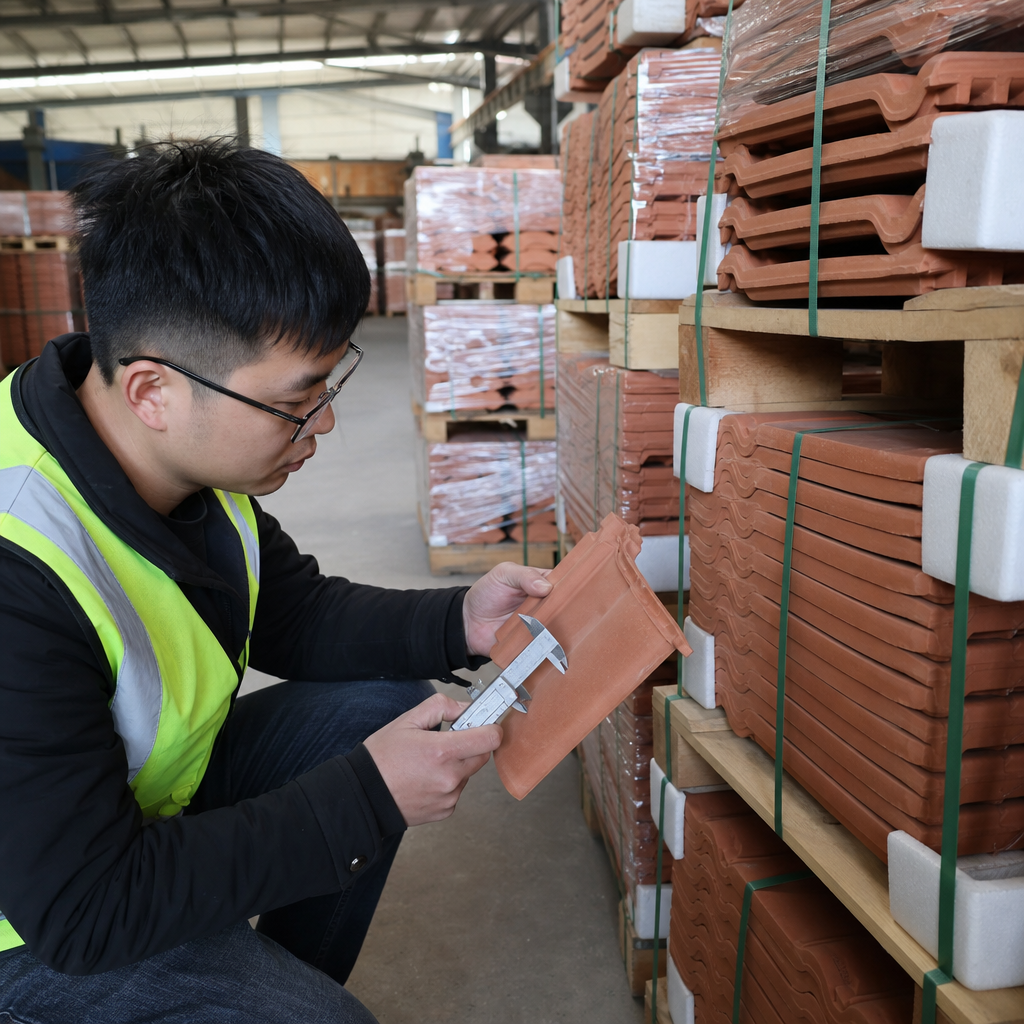
Roof tiles and clay bricks are some of the heaviest, most fragile products South African importers bring from China. A cracked tile batch means roof leaks, project delays, and disputes with builders in Johannesburg or Cape Town. Independent inspection catches dimensional drift, structural defects, and moisture damage before your container leaves the Chinese port.
What Roof Tile Defects Slip Past Chinese Factory QC?
😰 Stress #1: Warpage and bowing. Fired clay tiles cool unevenly in the kiln, causing a banana curve. When laid on an SA roof, warped tiles lift at corners — wind drives rain underneath.
The fix: Place each sampled tile on a flat granite surface plate. Measure gap with a feeler gauge. Warpage over 0.5% of length = reject that pallet.
😰 Stress #2: Crazing (hairline glaze cracks). Microscopic fissures in the glaze layer. Invisible on the factory floor, but after 3 months of Highveld UV + rain, they widen into visible cracks that absorb moisture and freeze-expand in winter.
The fix: Apply red dye penetrant to the glaze surface, wipe after 5 minutes. Any red residue trapped in cracks = crazing failure.
Step 1: Dimensional Tolerance Check
Measure 10 tiles per pallet layer (corner + center). SA tolerance standard:
| Parameter | Acceptable | Reject |
|---|---|---|
| Length (concrete tile) | ±2mm | >3mm variance |
| Thickness (clay brick) | ±1mm | >1.5mm variation |
| Warpage | ≤0.5% length | >0.5% = roof gap |
| Diagonal (squareness) | ≤3mm | Hip/ridge mismatch |
Step 2: Water Absorption & Strength Testing
Boil a tile sample for 5 hours in water, weigh before and after. SA roof tiles should absorb under 6% by weight. Clay bricks under 15%. Overshoot means the tile is porous — in Cape Town's rainy season, it'll saturate and add 30%+ weight to the roof structure.
Crush test 5 bricks per production batch. Minimum 7 MPa compressive strength for non-load-bearing walls, 12 MPa for structural. Foshan and Zibo factories commonly hit 15-20 MPa, but the factory's test certificates could be weeks old — fresh production may differ.
Step 3: Packaging for SA Sea Freight
😰 Stress #3: Broken corners on arrival. Container ships roll. A 20-ton stack of roof tiles shifts 5cm in heavy weather. By the time your container reaches Durban, 15% of edge tiles have snapped corners.
The fix: Inspect packaging BEFORE loading:
- ✅ Wooden edge protectors on every tile stack (minimum 5mm thick)
- ✅ Steel strapping × 4 bands per pallet (plastic breaks in 40°C container heat)
- ✅ Interlayer foam sheets, minimum 3mm between tile layers
- ✅ Shrink-wrap full pallet with moisture barrier
- ✅ Pallet base slats: no more than 15cm gaps (prevents sagging)
- ✅ Corner protectors on outer pallet faces
FAQs
Should I use General AQL Level II for roof tile inspection?
Yes — Level II normal is standard. But for critical structural defects (full-thickness cracks), use S-4 special inspection level instead. Zero critical defects allowed.
Can CloudSpects inspect at the kiln site outside Foshan or Zibo?
Yes — our inspectors cover all major tile and brick clusters in Guangdong, Fujian, and Shandong. We can visit the factory warehouse or the loading container — same rate, R2,900 per man-day.
What if the tiles pass factory QC but fail our inspection?
This happens regularly — factory QC is fast visual check. Our inspection is AQL Level II with dimensional measurement and water absorption test. The factory reworks before the container closes. CloudSpects pays the factory in RMB on your behalf — you send ZAR, we settle the rework cost with the supplier.
Real Inspection: Roof Tile Batch in Foshan
August 2025 — a Johannesburg building materials importer ordered 18,000 concrete roof tiles from a Foshan factory. Our inspector sampled 315 tiles. Found: 12 tiles with >0.7% warpage (reject), 8 tiles with corner chips >5mm (reject), 2 pallets with plastic strapping instead of the specified steel. The factory re-strapped both pallets and replaced rejected tiles. The client avoided an estimated R85,000 in claims from their builders.
Book Your Roof Tile Inspection
Contact CloudSpects for a same-day quote — from R2,900 per man-day. We cover Foshan, Zibo, Quanzhou, and all major tile & brick clusters in China.
Frequently asked questions
What Roof Tile Defects Slip Past Chinese Factory QC?
😰 Stress #1: Warpage and bowing. Fired clay tiles cool unevenly in the kiln, causing a banana curve. When laid on an SA roof, warped tiles lift at corners — wind drives rain underneath.
Should I use General AQL Level II for roof tile inspection?
Yes — Level II normal is standard. But for critical structural defects (full-thickness cracks), use S-4 special inspection level instead. Zero critical defects allowed.
Can CloudSpects inspect at the kiln site outside Foshan or Zibo?
Yes — our inspectors cover all major tile and brick clusters in Guangdong, Fujian, and Shandong. We can visit the factory warehouse or the loading container — same rate, R2,900 per man-day.
What if the tiles pass factory QC but fail our inspection?
This happens regularly — factory QC is fast visual check. Our inspection is AQL Level II with dimensional measurement and water absorption test. The factory reworks before the container closes. CloudSpects pays the factory in RMB on your behalf — you send ZAR, we settle the rework cost with the supplier.